
A reference photograph can communicate a mood without explaining what the customer actually wants to reproduce. Is it the color, the close spacing, the irregular outline, or the way the poles meet the surrounding architecture? Answering that question makes a sample review much more useful.
Supply Scout’s products have been used in thousands of completed projects during our 20 years serving the specialty building materials industry. That experience supports a simple principle for visual approvals: describe the important details before asking everyone to approve “the look.”
For a hotel entrance, restaurant ceiling, or themed interior, a clear sample process can connect the design concept to the material order.
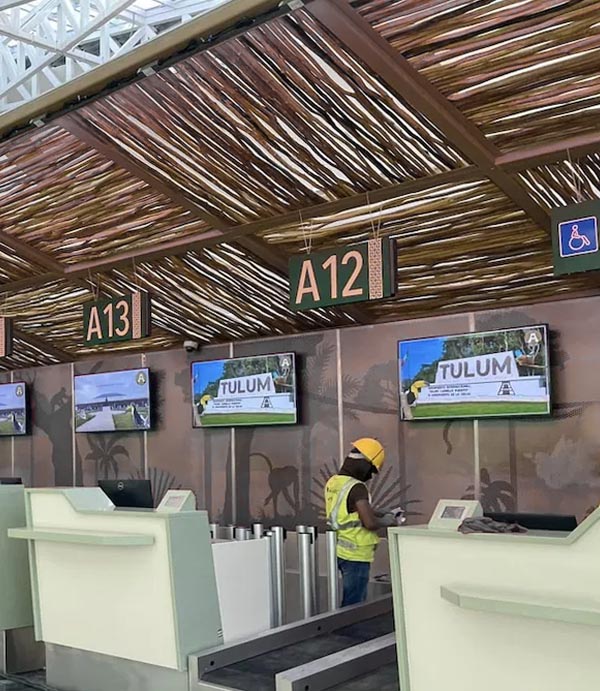
Identify what the reference image proves
Gather a small number of relevant images and annotate them. One may show the preferred pole arrangement, another a finished edge, and a third the relationship to lighting. Explain which feature matters in each image rather than treating every detail as part of the specification.
Do not assume the image establishes the product’s dimensions, treatment, or performance. Those details need separate confirmation. Likewise, a photograph from another project does not establish that the proposed application is structurally suitable.
Use both wide views and close-ups. The wide view communicates scale and context; the close-up helps explain the surface and connection appearance.
Separate natural character from installation choices
Natural eucalyptus varies in grain, color, and texture. The design should acknowledge that character while still defining the installer’s decisions: alignment, spacing, end treatment, and the overall pattern.
Ask what variation is acceptable in the areas guests will see most closely. A decorative feature viewed across a large room may have different visual priorities from a detail beside a seating area. Avoid using a single vague requirement such as “uniform” without explaining what needs to align.
Review the available eucalyptus pole options alongside the reference images so the conversation stays connected to the material being considered.
Choose the right kind of sample
A loose sample can help with surface appearance, but it cannot show every aspect of an installed assembly. Ask what size and type of sample would answer the actual decision, and confirm availability rather than assuming a particular sample service.
A mockup becomes more useful when it includes several adjoining poles, the proposed spacing, one typical connection, and a finished edge. For a ceiling, show the background behind the poles. For a screen, view the arrangement from both sides.
Treat the mockup as a question to resolve. If the team is choosing between two spacing options, keep the other variables consistent so the comparison is meaningful.
Review under the intended conditions
Examine the proposed appearance under lighting that resembles the finished space. Review from the entrance and from the normal occupied position. A surface seen at eye level under a work light may look different from the same material overhead in a dim restaurant.
For an outdoor feature, consider the surrounding materials and the desired appearance over time. Ask for guidance on the proposed finish and care expectations. Do not assume a sample photograph is a promise that the color will remain unchanged.
If an existing installation must be matched, provide close-ups, wider photographs, and measurements. Explain which elements must coordinate and which can intentionally differ.
Include the people who will use the approval
The designer may judge appearance, while the installer needs a reproducible detail and the purchasing team needs an order description. Bring those perspectives together before signing off.
Where relevant, ask the property’s operations team to review cleaning access and service requirements. A visually approved detail can still create a maintenance problem if it blocks an access point or cannot be reached safely.
Have the responsible specialists resolve structural, fire, or other performance requirements separately. A visual sample approval should never be treated as approval of technical matters it does not demonstrate.
Record the decision clearly
Write down the approved material reference, layout, spacing method, edge treatment, and accepted range of appearance. Attach photographs and the relevant drawing revision. Identify anything still pending, such as final lengths or connection design.
For example, a hypothetical restaurant could approve the visual character of a ceiling mockup while leaving the exact bay dimensions subject to site verification. Recording that distinction prevents an appearance decision from becoming an accidental fabrication instruction.
Keep an agreed reference available during installation where practical. If a change is proposed, record the reason and obtain the appropriate review rather than allowing a series of small substitutions to alter the overall design.
Carry the approval into the quote
Translate the decision into the material schedule: requested sizes, quantities, intended application, and the reference that governs appearance. Include the project location, exposure, installation timing, and any documentation requirements.
Our pole planning guide explains the broader ordering questions. Share your references with Supply Scout to discuss material options and the next step toward a useful project quote.